

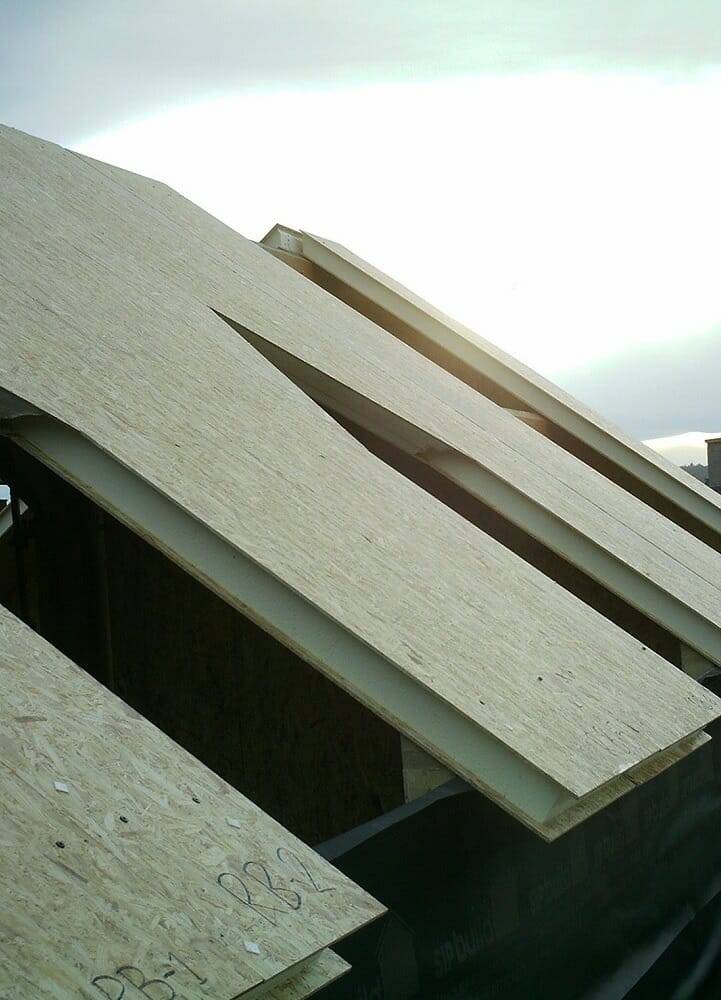
Timber Frame construction consists of a structural skeleton made from kiln-dried, strength-graded timber studs, rails, and joists. These components form the load-bearing walls, floors, and roof structure of the building. The frame is typically sheathed with performance-rated panel board, such as OSB or Fermacell, which adds rigidity and resists lateral forces.
The structural design of a Timber Frame allows it to carry both vertical and horizontal loads, with the timber studs transferring these loads directly to the foundations. Lateral stability is provided by the sheathing and bracing systems, ensuring excellent performance under wind loading and racking conditions.
Manufactured in precision-controlled factory environments, FrameCo’s Timber Frame systems are custom-designed for each project. This results in a build method known for its strength, adaptability, and construction speed. All frames are produced under rigorous quality assurance procedures to maintain consistent performance and compliance with UK regulations.
- BS EN 1995-1-1: 2004 + A1: 2008 – Eurocode 5: Design of timber structures – Common rules and rules for buildings
- BS EN 1995-1-2: 2004 – Eurocode 5: Structural fire design for timber buildings
- BS EN 594: 1996 – Test methods for racking strength and stiffness of timber frame wall panels
- BS EN 338: 2009 – Structural timber – Strength classes
- BS 5534: 2014 + A2: 2018 – Code of practice for slating and tiling (roofing applications)
- BS EN 1996-2: 2006 – Eurocode 6: Design of masonry structures – applicable for hybrid systems where timber connects to blockwork or brickwork
- BS EN 846-6: 2012 – Load capacity testing for wall ties – relevant when tying timber frames to masonry leaf construction
Applications and Advantages of Timber Frame Construction
Timber Frame is one of the most established and adaptable forms of structural construction in the UK, used extensively across residential, commercial, and institutional projects. Its speed, precision, and compatibility with a wide range of finishes make it a go-to method for developers, self-builders, and contractors alike.
Core Applications
Our systems are fully load-bearing and capable of forming the primary structure of the building. This includes all internal and external walls, floor platforms, and roof assemblies. The frame also provides a natural cavity for insulation, service runs, and airtightness detailing, making it extremely efficient to work with during fit-out.
Why Timber Frame Performs So Well
SIPCO panels are subjected to rigorous testing procedures to guarantee their exceptional performance. These tests include loading panels with a uniformly distributed load (UDL) to measure strength and deflection between two supports, axial loads placed centrally and eccentrically, racking loads, and shear and bending loads on the panel joints. The robustness of the joints between individual panels allows for potential spans over openings, supported by adjacent panels.
Proven Build Method
Timber frame has been widely used in the UK for decades. It is one of the most established structural systems available, with predictable load paths and framing principles that are well understood by structural engineers, warranty providers and local Building Control.
Precise On-Site Assembly
Frames are delivered as pre-cut components, including studs, rails, lintels, and joists, allowing for fast and accurate on-site assembly. Because it is a dry construction method, timber frame avoids the delays and variability that come with wet trades.
Material Efficiency
Timber offers excellent strength-to-weight performance, meaning less material is needed to carry loads compared to masonry or steel. Structural layouts can be easily adjusted to suit complex designs, larger openings or higher load zones.
Straightforward Detailing
Details at junctions, openings and wall/floor interfaces are clear and familiar to most construction teams. Moisture control, fire stopping and insulation placement follow well-established practices, helping reduce risk and site errors.
Builder-Friendly and Flexible
Timber frame is easy to work with using standard tools and methods. It suits a wide range of trades without specialist knowledge and makes follow-on work like plumbing, electrical and internal finishes straightforward. It also offers future flexibility, whether for adaptation, repair or extension.
QUICK LINKS:

ACOUSTIC
PERFORMANCE

FIRE
PERFORMANCE

THERMAL
PERFORMANCE

SUSTAINABILITY
PERFORMANCE

VENTILATION
PERFORMANCE

DURABILITY
PERFORMANCE